
01
What is it?
It is a way to work directly with the feeling underneath a problem so it stops running the pattern from the background. The point is not to suppress it or explain it forever, but to work with it in real time.
Loading
We use cookies to understand how you use our site and improve your experience. Privacy Policy
A feeling management system that puts you in control.
It is a series of tools that allow you to interact with your mind and completely change your negative feelings and perceptions. Specific verbal phrases will trigger a subconscious meditation in the user. That meditation will clear the emotional charge and give the user access to insight and information that was buried underneath the negative feelings.
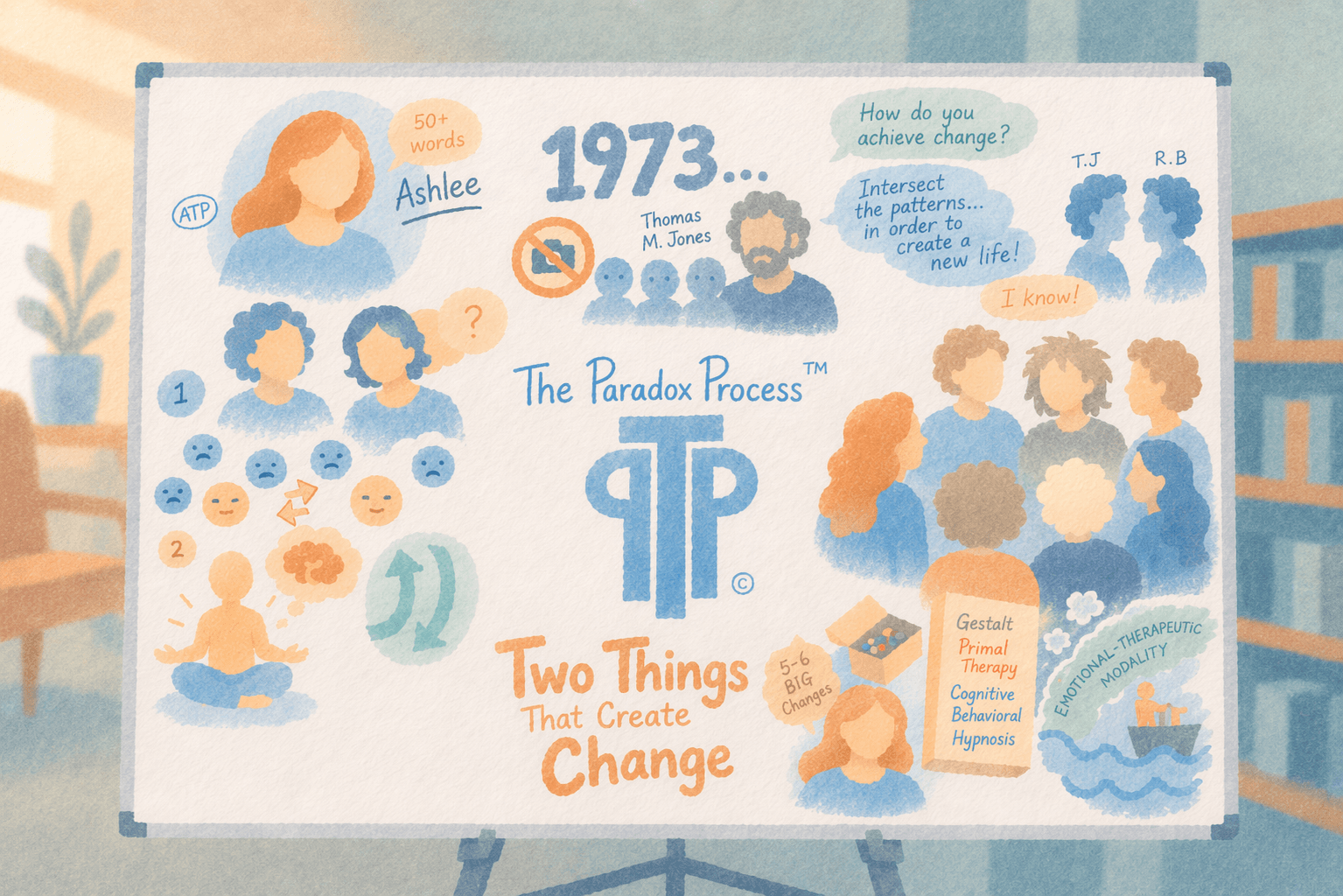
If a feeling keeps shaping what seems true, then learning how to work with feelings changes more than mood. It changes what you notice, what you expect, and what starts to feel possible again.
01
It is a way to work directly with the feeling underneath a problem so it stops running the pattern from the background. The point is not to suppress it or explain it forever, but to work with it in real time.
02
You do not have to spend months circling a problem before anything shifts. This work starts with what is happening now, so change can begin in the room instead of staying theoretical.
03
Because feelings become stories, stories harden into expectations, and expectations shape behavior. When the feeling changes, the rest of the pattern often loosens too.
In 1973, Thomas M. Jones was working in a therapeutic community with substance-challenged kids when his own personal life fell apart. A devastating breakup left him in extraordinary pain, and it pushed him toward a question that would shape the rest of his life.
Around that time, he met Rodger Bell, another therapeutic community director going through a similar upheaval. Together they built Life Lab, a laboratory for living where they explored every system they could find. Some offered insight. Some offered relief. None seemed to change the feeling itself.
What if feelings were not fixed, and could actually be changed?
Twelve years later, Rodger brought Thomas a deceptively simple experiment. Think of an issue that carries emotional charge, he said. Close your eyes and repeat: It's okay, I can accept that.
What happened next changed everything. The pain eased almost immediately, and with it came insight. Not numbness. Not avoidance. Relief, understanding, and a different sense of what might be possible.

“We've created something that changes your feelings and emotions in the moment and gives you insight and information as it does.”
What began as a simple discovery in 1985 has grown into a direct way to work with feelings, so they no longer run your life from behind the scenes.
The goal is not to avoid your feelings. It is to change your relationship to them so relief, clarity, and different choices become available.
Today, The Paradox Process is used in private sessions, live classes, workshops, retreats, and training programs by people who want a more direct way to work through what has been keeping them stuck and move toward what they actually want.

Co-Founder & Executive Director
Thomas M. Jones is a psychotherapist, author, musician, and co-founder of The Paradox Process. For more than 40 years, he has worked with people who want more than explanation alone. They want something to actually change.
People come to him from many different worlds, including leadership, medicine, performance, journalism, and helping professions, usually because they want something more direct than insight by itself.
His style is direct, funny, and alive in the room. He is less interested in a beautiful explanation after the fact than in whether something moves while you are there. He continues to lead classes, retreats, training, and private sessions in New York City.
Thomas also co-founded the Healing & Discovery Foundation, a nonprofit bringing practical emotional education to young people.
Healing & Discovery Foundation
A 501(c)(3) nonprofit dedicated to bringing practical emotional education to young people.
The foundation works toward a world where emotional education is treated as essential life training, right alongside reading, writing, and math.
Visit the foundationThe work does not live with Thomas alone. A growing network of facilitators carries it into private sessions, Community Nights, trainings, and different kinds of support.
Not exactly. The Paradox Process shows up in private sessions, classes, retreats, and personal practice. It can live alongside therapy, but the method itself is about working directly with emotional charge and what it creates.
No. Most people begin with curiosity, skepticism, or simply a desire for relief. The clearest way to understand the work is to experience it for yourself.
It is especially helpful for people who feel stuck in anxiety, self-judgment, relationship pain, or repeating patterns they have not been able to shift through insight alone.
For most new people, the best first step is a free introductory session. If that feels like too much right now, Community Nights or a Paradox Class can be a gentler place to begin.
Try out the Process
Try out the Process. Start with a free introductory session and a calmer place to begin. Let's find out together.
Free introductory session / first conversation / no performance required
Prefer to ask a question first? info@paradoxprocess.org